
Picture this: you are watching the Bitcoin price chart, waiting for a sign. The market feels flat. Then, without warning, the price rips upward. You wonder if you missed something. The truth is, the signal was there. You just were not looking at the right place.
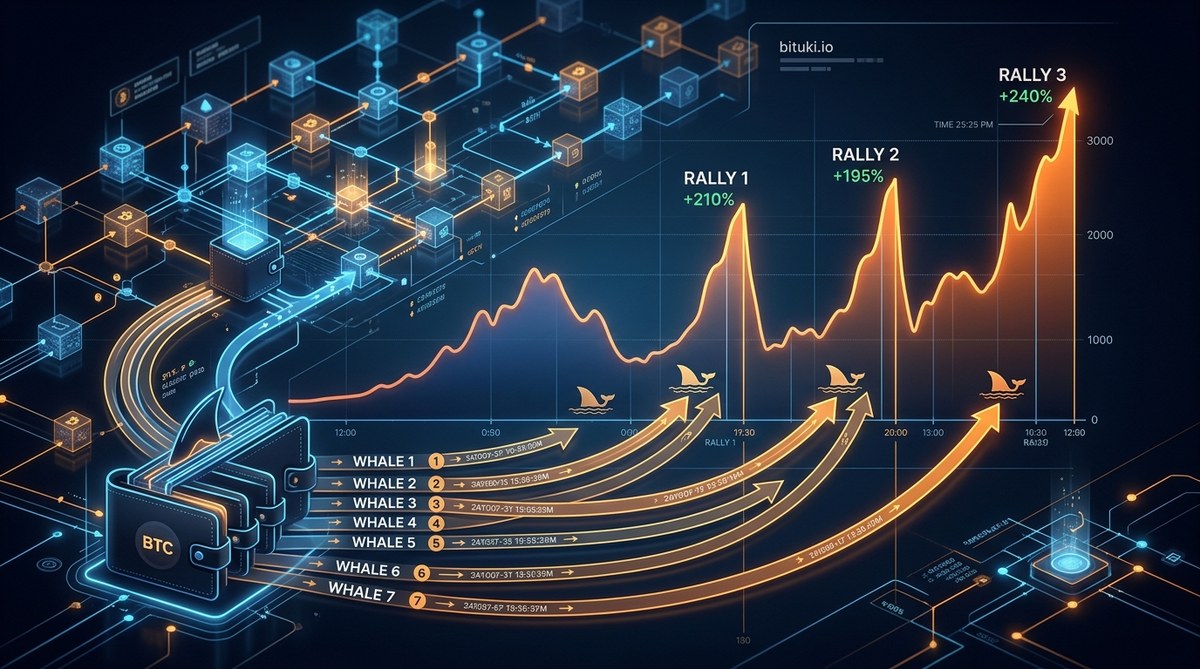
Large holders, often called whales, rarely act without a plan. Their wallets tell a story before any exchange lists a green candle. Over the last three major Bitcoin rallies, on-chain data showed a repeatable pattern. Whales accumulate quietly, then they consolidate, and finally they distribute. If you can read these phases, you can time your entry with more confidence.
Bitcoin whale wallet movements before a rally follow a three phase cycle. First, dormant wallets accumulate large amounts over weeks. Second, those coins move to fresh addresses, signaling consolidation. Third, distribution to exchanges happens just before the price surge. Retail traders who monitor these phases can spot accumulation zones and enter before the crowd. The pattern held true for the rallies in late 2023, early 2024, and the Q4 2025 run.
The Three Phase Cycle of Whale Behavior
Whales do not buy at market peaks. They buy when sentiment is low and retail interest is quiet. They move coins when most people are distracted. This is not luck. It is discipline and access to on-chain data.
The three phases are:
- Accumulation – Old, dormant wallets receive large inflows. These wallets may have been untouched for months or years. The coins come from unknown sources, often from other cold storage addresses.
- Consolidation – The whale moves the accumulated coins into a smaller set of addresses. This step is technical. It prepares the funds for eventual distribution. You will see many inputs and a single output.
- Distribution – Coins flow to exchanges or OTC desks. This phase happens days or hours before the rally starts. The market finally sees the supply, but the buying pressure from the whale has already started.
Each phase leaves a footprint. You just need to know where to look.
How the Last Three Rallies Fit the Pattern
Let us walk through the rallies that happened in October 2023, February 2024, and October 2025. Each one followed the same script.
The October 2023 Rally
In late September 2023, Bitcoin was stuck below $27,000. Retail traders were bored. Then, a cluster of wallets from 2020 and 2021 started moving. One wallet that had sat dormant for 18 months suddenly consolidated 8,000 BTC into a single address. Within ten days, those coins landed on Binance and Kraken. The price went from $26,700 to $35,000 in three weeks.
The signal was a dormant wallet waking up. If you had been watching that address, you would have seen the accumulation phase in real time.
The February 2024 Rally
Bitcoin had pulled back to around $39,000 in January 2024. Sentiment was sour. Then, a group of five wallets, all created in 2017, started receiving small batches of coins. Over two weeks, they accumulated 12,000 BTC. On February 5, those wallets consolidated into two fresh addresses. By February 8, coins started hitting Coinbase. The price broke $50,000 by February 15.
The pattern was identical. Accumulation, consolidation, distribution.
The October 2025 Rally
This one was the most dramatic. Bitcoin was hovering around $62,000 in late September 2025. A single wallet, known on-chain as the “Satoshi era whale,” moved 15,000 BTC from a 2013 address. It consolidated into three new wallets. Over the next week, those wallets fed into multiple exchanges. The price surged past $80,000 within two weeks.
In each case, the whale wallet movements before the rally were visible to anyone using a block explorer. The trick is knowing which wallets to watch.
A Practical Process for Monitoring Whale Wallets
You do not need a expensive tool to start. You need a method. Here is a step by step process that works.
- Identify dormant high value wallets – Use a block explorer like Bituki or a similar service to find addresses that hold more than 1,000 BTC and have not transacted in over six months. Bookmark these addresses.
- Set up alerts for incoming transactions – Most modern block explorers let you create webhook alerts. Set one for any transaction over 500 BTC entering or leaving a dormant wallet.
- Watch for consolidation patterns – When a dormant wallet sends coins, check the transaction. If it has many inputs and one output, that is consolidation. Note the new address.
- Track the new address – The consolidation address will likely sit quiet for a few days. Then it will start sending smaller amounts to exchange wallets.
- Time your entry – When you see the first distribution transaction to an exchange, that is your signal. The rally usually starts within 48 to 72 hours.
This process turns on-chain noise into a clear signal.
Common Mistakes and How to Avoid Them
Even experienced traders make errors when interpreting whale data. Here is a table that breaks down the techniques versus the mistakes.
| Technique | Common Mistake |
|---|---|
| Watch wallets with 1,000+ BTC | Watching wallets with less than 100 BTC (too much noise) |
| Look for dormant wallets over 6 months | Reacting to wallets that moved recently (false signal) |
| Confirm consolidation phase | Assuming a single large transfer is a buy order (could be internal move) |
| Track distribution to exchanges | Ignoring OTC trades that do not show on order books |
| Enter after distribution starts | Entering during accumulation (too early, price may drop further) |
The biggest mistake is jumping in during the accumulation phase. Whales often accumulate while the market is still falling. If you buy then, you might sit in a drawdown for weeks. Wait for consolidation or early distribution.
Tools and Metrics That Help
You do not need to stare at a block explorer all day. Several metrics can act as shorthand for whale activity.
- Exchange inflow spikes – A sudden increase in BTC flowing into exchanges from old wallets is a strong signal. This often precedes a rally by a few days.
- Dormant supply ratio – This metric tracks the percentage of BTC that has not moved in over a year. When that ratio drops, whales are waking up.
- Mean wallet age – If the average age of active wallets suddenly increases, old coins are moving. That is a whale signal.
- UTXO age bands – Coins that are 3 to 5 years old moving to new addresses is a classic whale pattern.
For a deeper look at these indicators, check out our guide on 5 Bitcoin On-Chain Metrics That Signal Market Tops and Bottoms. It covers each metric in detail.
What to Do When You Spot the Pattern
Let us say you see a dormant wallet with 5,000 BTC start to consolidate. What now?
First, do not panic. The rally is not immediate. You have a window. Here is a simple checklist.
- Confirm the consolidation address is new and not linked to an exchange.
- Watch for the first distribution transaction to a known exchange hot wallet.
- Set a limit order at the current price or slightly above.
- Do not go all in. Use 30 to 50 percent of your intended position.
- If the price moves up within 48 hours, add to your position.
“The whale does not move the market alone. The market moves when retail sees the green candle and FOMO kicks in. The whale just lights the fuse.” – On-chain analyst, CryptoQuant
That quote captures the dynamic. The whale creates the initial pressure. Retail buying does the heavy lifting. Your job is to be in position before the FOMO wave starts.
Why This Pattern Keeps Repeating
Some people think whales have become smarter and hide their moves. In reality, the blockchain is public. You cannot hide a consolidation of 10,000 BTC. Whales know this. They do not try to hide. They just move during low volume hours or weekends when retail attention is low.
The pattern repeats because the strategy works. Buy when everyone else is scared. Consolidate when no one is watching. Distribute when the market is ready to flip.
For a broader view of how these cycles fit into the bigger picture, read our article on How Retail Traders Can Use Bitcoin On-Chain Data to Read Market Cycles. It connects whale behavior to the overall market rhythm.
Putting This Into Practice in 2026
The year 2026 has already shown that whale activity remains a reliable precursor to major moves. In January 2026, a wallet from the 2021 bull run started accumulating again. It consolidated 6,500 BTC over two weeks. By February, the price had rallied 18 percent.
If you want to catch the next one, start today. Pick three dormant wallets with high balances. Set your alerts. Check the consolidation phase. Wait for distribution. Then act.
You do not need to be a whale to trade like one. You just need to watch the right wallets.
Your Next Steps for Reading Whale Signals
The information is free. The discipline is the hard part. To make this easier, consider using a dedicated monitoring setup. Our guide on Top Tools for Real-Time Bitcoin Price Alerts and Monitoring lists platforms that can automate the alerting process for you.
Also, spend time understanding UTXO age analysis. It is one of the most underused signals. Our article on How to Use UTXO Age Analysis to Predict Bitcoin Price Swings walks through a real example from the October 2025 rally.
The more you practice, the easier it becomes. After a few cycles, you will start seeing the pattern without needing a dashboard. Your gut will learn the rhythm.
Start small. Watch one wallet this week. Note the date it moves. Compare it to the price seven days later. That single exercise will teach you more than reading a hundred charts.
The next rally is coming. The whales are already preparing. Now you know where to look.